
When cybersecurity is treated as something that belongs only to IT, one important reality gets missed:
IT cannot control every decision employees make.
Cybersecurity decisions happen throughout a furniture manufacturing business every day.
Accounting receives requests to change supplier banking information.
Purchasing receives attachments and links from vendors.
Sales communicates with customers.
Executives receive targeted phishing messages.
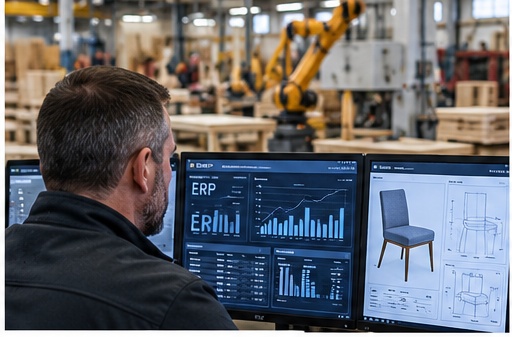
Operations relies on ERP and production systems.
Employees access Microsoft 365.
Third-party vendors may connect remotely to equipment or software.
Internal IT sits in the middle of all of it.
That means cybersecurity needs to become an operational responsibility, not simply an IT responsibility.
Leadership sets expectations.
Employees need to know what looks unusual and how to report it.
Finance needs procedures for verifying payment changes.
Operations needs to understand which systems are most critical.
IT needs the authority and support to enforce security controls, even when those controls create a little inconvenience.
Everyone has a role.
The same is true during a cyber incident.
Many businesses believe they know what they would do until employees suddenly cannot access files, email stops working, or an important application goes offline.
Then basic questions become difficult:
- Who makes the decision to shut systems down?
- Who calls IT?
- Who contacts the cyber insurance carrier?
- How will employees communicate if email is unavailable?
- Who talks to customers?
- Who talks to suppliers?
- Which systems need attention first?
- Who has authority to approve emergency spending?
- Who coordinates with outside vendors?
Those decisions should not be made for the first time during a crisis.
A strong incident-response plan connects cybersecurity directly to operations.
Leadership knows who has decision-making authority.
Operations knows which systems affect production.
IT knows when equipment or accounts should be isolated.
Employees know how to communicate if normal systems are unavailable.
Outside partners already understand their role.
For furniture manufacturers with internal IT staff, co-managed cybersecurity can provide an additional layer of support.
Your internal team knows the environment.
They know the ERP.
They know the users.
They know the production workflow.
They know the vendors.
They know where the technology headaches usually appear.
An outside cybersecurity partner adds monitoring, specialized expertise, incident-response experience, testing, and additional coverage.
The objective is not to replace internal IT.
It is to make sure they are not standing alone when the business depends on them most.
Strong cybersecurity protects more than data.
It helps protect production, customer commitments, supplier relationships, and the systems your business depends on every day.

