
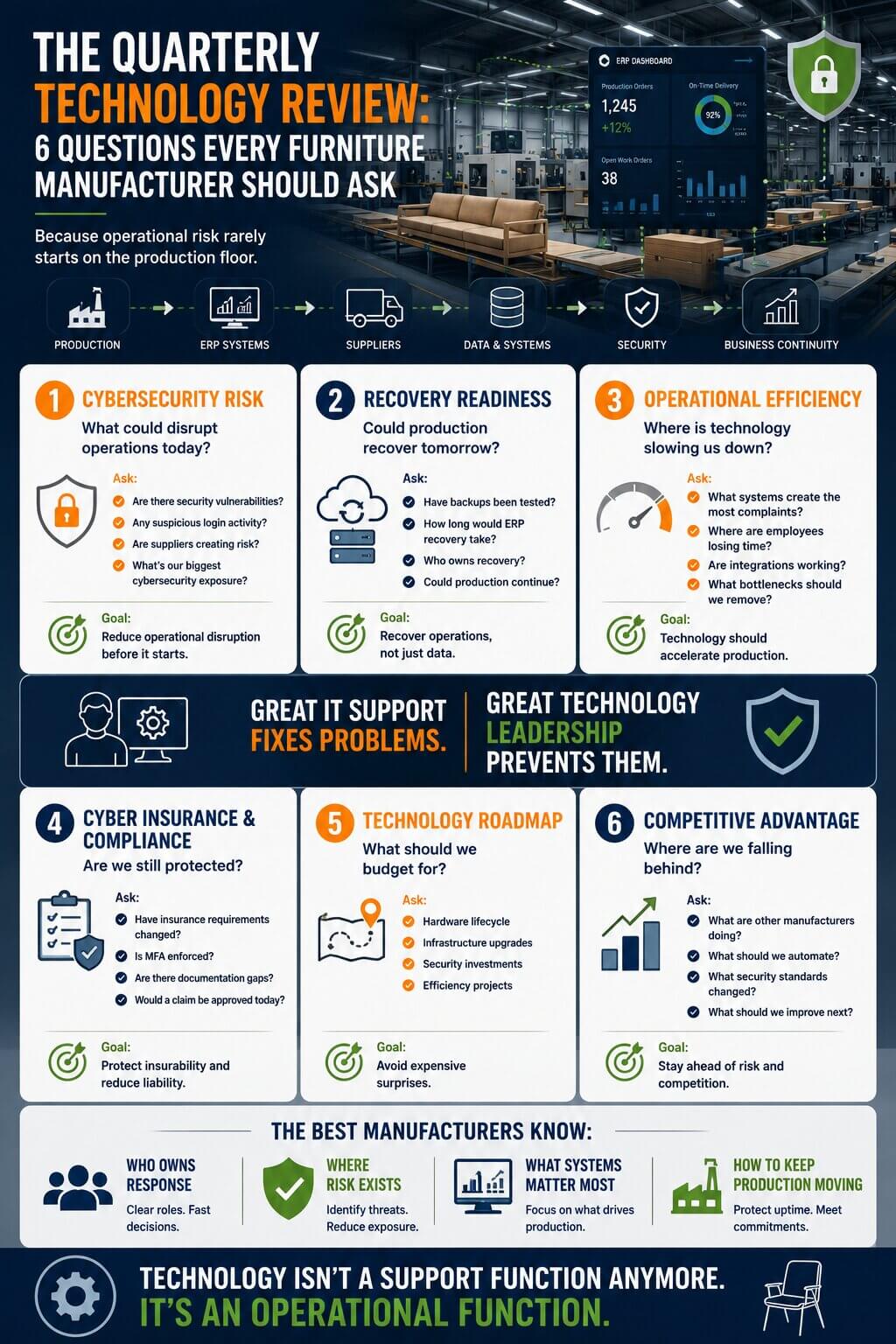
Technology reviews shouldn’t be about technology.
They should be about operational resilience.
Every quarter, furniture manufacturers review production schedules, supplier performance, inventory levels, and financial results.
Yet many never sit down and ask whether their technology environment is helping operations move faster or quietly creating risk.
The manufacturers that stay ahead don’t wait until something breaks.
They ask better questions.
Here are six questions every manufacturing leader should be asking their IT team, MSP, or technology partners every quarter.
1. What Cybersecurity Risks Could Impact Operations Today?
Every manufacturing environment has risk.
The important question is whether those risks are understood and actively managed.
Ask:
- Are there vulnerabilities affecting our ERP, production systems, or Microsoft 365 environment?
- Have there been unusual login attempts or suspicious activity?
- Are there users, devices, or suppliers creating unnecessary exposure?
- What is the single biggest cybersecurity risk facing us right now?
You don’t want reassurance.
You want visibility.
A strong IT partner should be able to explain your biggest risks in business terms, not technical jargon.
2. If Ransomware Hit Tomorrow, How Fast Could We Recover?
Most manufacturers have backups.
Far fewer have tested recovery.
Those are not the same thing.
Ask:
- When was our last recovery test?
- How long would ERP restoration actually take?
- Could production continue during recovery?
- Are cloud applications and Microsoft 365 protected?
- Who owns recovery if something happens?
The question isn’t whether backups exist.
The question is whether production can recover.
3. Where Is Technology Slowing Down Operations?
Most operational inefficiencies don’t create help desk tickets.
Employees simply work around them.
A purchasing manager waits for reports.
Production data updates slowly.
Customer information exists in multiple places.
Teams create manual processes to compensate.
Ask:
- What systems generate the most complaints?
- Where are employees losing time?
- Are integrations working properly?
- What operational bottlenecks should we eliminate?
Technology should accelerate production.
Not create friction.
4. Are We Meeting Cyber Insurance and Security Requirements?
Cyber insurance requirements continue to evolve.
Many manufacturers assume they are compliant because they were compliant last year.
That’s a dangerous assumption.
Ask:
- Have cybersecurity insurance requirements changed?
- Are we meeting current MFA requirements?
- Are there documentation gaps?
- Do we need additional security controls?
- Are there compliance issues that could affect future claims?
A failed insurance claim is often more expensive than the security investment that could have prevented it.
5. What Technology Investments Should We Plan For?
The best technology decisions happen before they’re urgent.
Ask:
- What hardware is approaching end-of-life?
- What systems should be upgraded in the next 12 months?
- What cybersecurity investments should we budget for?
- What projects will improve operational efficiency?
Quarterly planning prevents emergency spending.
And emergency spending is usually expensive spending.
6. Where Are We Falling Behind Other Manufacturers?
This may be the most important question.
Technology changes quickly.
Cyber threats change even faster.
Ask:
- What are other manufacturers doing that we’re not?
- Are there automation opportunities we’re missing?
- Have cybersecurity best practices changed?
- Are there operational improvements we should evaluate?
Your technology partners should help you stay ahead of industry trends, not simply react to problems.
The Red Flag Manufacturing Leaders Should Watch For
If your IT provider or internal IT team cannot confidently answer these questions, that’s a problem.
Technology support should be proactive.
Not reactive.
The goal isn’t fixing issues after production is impacted.
The goal is preventing disruptions before they affect operations.
The Bottom Line
The strongest manufacturers don’t review technology because they love technology.
They review technology because it affects:
- Production
- Customer commitments
- Supplier relationships
- Operational efficiency
- Profitability
Technology is no longer a support function.
It’s an operational function.
And every quarter should include a conversation about whether it’s helping your business move forward or quietly holding it back.

