
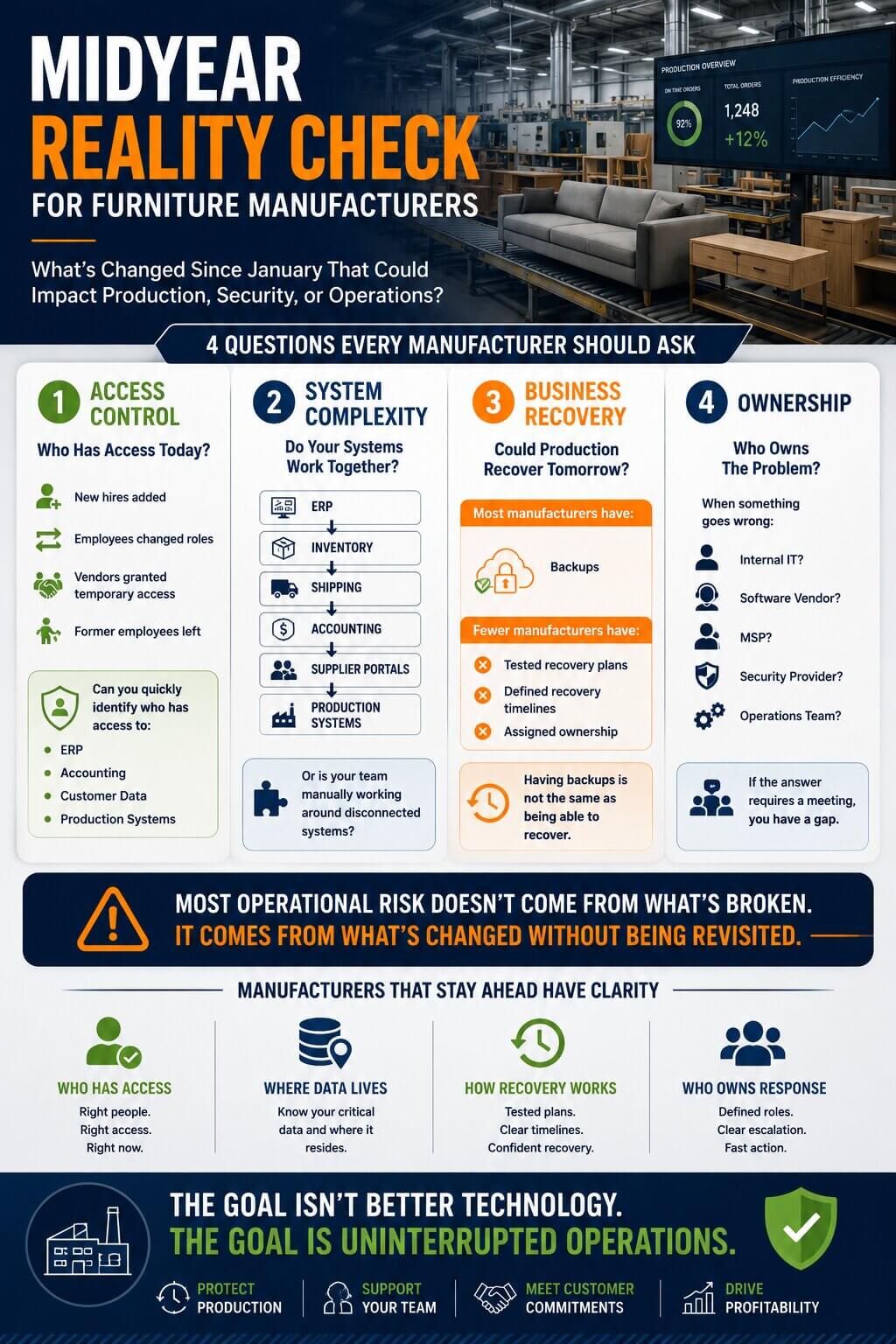
What’s Changed Since January That Could Impact Operations?
Your manufacturing operation hasn’t stood still since January.
Neither has your technology environment.
You’ve hired employees.
Added suppliers.
Implemented new software.
Expanded production capabilities.
Adjusted workflows.
Made dozens of decisions to keep orders moving and customers happy.
The challenge isn’t the changes themselves.
It’s what those changes leave behind.
By midyear, most furniture manufacturers are operating on assumptions about who has access to what, where critical data lives, whether backups will actually work, and who owns cybersecurity responsibilities when something goes wrong.
Those assumptions create operational risk.
Here are four areas manufacturing leaders should review before those risks become expensive.
1. Access Has Expanded. Has Anyone Reviewed It?
Every manufacturing company has experienced it.
A new employee needs ERP access.
A production manager requires additional permissions.
A supplier receives temporary access.
An employee changes roles.
Someone leaves the company.
Access gets added quickly.
It rarely gets removed with the same urgency.
As a result:
- Employees often have access beyond what their role requires
- Former employees may still have active accounts
- Vendors and contractors retain permissions long after projects end
- Leadership lacks visibility into who can access critical systems
For manufacturers, this isn’t just a cybersecurity issue.
It’s an operational risk issue.
If you cannot quickly answer who has access to your ERP, accounting platform, production data, or customer information, it’s time for a review.
2. Your Technology Stack Has Grown More Complex
Most manufacturers didn’t design their technology environment all at once.
It evolved.
ERP was added.
Inventory systems were expanded.
Shipping software was introduced.
Supplier portals were connected.
Cloud applications appeared.
Every decision solved a legitimate business problem.
Collectively, they created complexity.
Today, many furniture manufacturers struggle with:
- Data spread across multiple systems
- Incomplete integrations
- Duplicate information
- Manual workarounds
- Inconsistent reporting
The danger isn’t obvious.
It appears later as:
- slower decision-making
- operational inefficiencies
- reporting discrepancies
- cybersecurity blind spots
The question is simple:
Do your systems work together?
Or has your team become the integration layer?
3. Are You Confident You Can Recover From An Outage?
Most manufacturers have backups.
Far fewer have tested recovery.
There is a difference.
If ransomware hit tomorrow…
If your ERP became unavailable…
If production files disappeared…
Would your team know exactly what happens next?
Or would everyone start figuring it out in real time?
Manufacturers often discover too late that:
- backups were incomplete
- recovery timelines were unrealistic
- responsibilities were unclear
- recovery procedures were never tested
The true test is not whether backups exist.
The true test is whether production can resume when something fails.
4. Responsibility Has Become Blurry
Many furniture manufacturers now operate with a combination of:
- internal IT staff
- outside vendors
- software providers
- cybersecurity consultants
- cloud providers
As the environment grows, ownership becomes less clear.
When a security incident occurs…
When systems stop communicating…
When production is affected…
Who takes charge?
If the answer requires a meeting, multiple phone calls, or figuring it out in real time, there is a gap.
The organizations that recover fastest have clearly defined ownership before problems occur.
Most Operational Risk Comes From Change
Not failure.
Change.
New employees.
New suppliers.
New software.
New processes.
New vendors.
Every change introduces complexity.
And complexity creates risk when it isn’t reviewed.
What Manufacturing Leaders Should Do Next
The manufacturers that stay ahead of operational and cybersecurity risk are not doing anything revolutionary.
They simply maintain clarity.
They know:
- who has access to critical systems
- where business data resides
- how recovery works
- who owns incident response
That clarity reduces downtime.
Improves security.
Supports cyber insurance requirements.
And keeps production moving.
Because the goal isn’t better technology.
The goal is uninterrupted operations.
Ask Yourself:
If a cyber incident, system outage, or supplier disruption happened tomorrow…
Would your team execute a plan?
Or create one on the fly?
The answer tells you more about your operational resilience than any technology audit ever will.

