
How Phishing Attacks Disrupt Production, Suppliers, and Operations
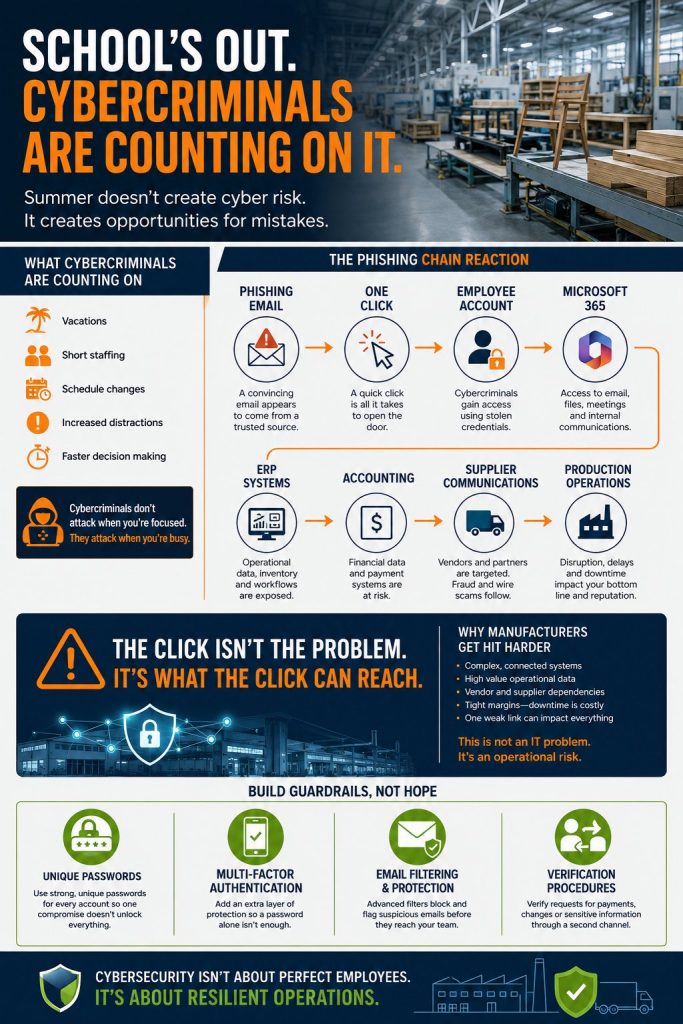 For furniture manufacturers, summer often brings operational changes.
Employees take vacations.
Temporary workers are added.
Key decision-makers become less available.
Production schedules remain aggressive.
Supplier relationships remain critical.
These changes create conditions cybercriminals actively exploit.
The risk is not that employees become careless.
The risk is that manufacturing operations become more fragmented, creating opportunities for phishing attacks, business email compromise, ransomware, and credential theft.
Why Are Furniture Manufacturers Targeted by Cybercriminals?
Furniture manufacturers are attractive targets because they rely on interconnected systems that support:
- ERP platforms
- Accounting systems
- Vendor portals
- Production scheduling
- Customer communications
- Supply chain operations
A single compromised account can provide access to multiple business-critical systems.
Cybercriminals understand that manufacturers often prioritize production continuity and may be more likely to pay to restore operations after an attack.
This makes manufacturing one of the most targeted industries for ransomware and phishing campaigns.
How Phishing Attacks Impact Manufacturing Operations
Many manufacturing leaders think phishing attacks are primarily an IT problem.
In reality, phishing attacks create operational risk.
A typical attack follows this pattern:
- An employee receives a convincing email.
- The employee clicks a malicious link or attachment.
- Credentials are stolen.
- Attackers gain access to business systems.
- Sensitive information is exposed.
- Operations are disrupted.
For furniture manufacturers, that disruption may affect:
- Purchasing
- Production planning
- Customer service
- Vendor payments
- Logistics coordination
The click itself is rarely the real problem.
The problem is what that click can access.
Why Summer Increases Cybersecurity Risk
Summer does not create cyber threats.
It creates conditions where threats are easier to miss.
Common summer risk factors include:
- Employee vacations
- Short staffing
- Increased workload
- Temporary workers
- More remote work
- Faster decision-making
Cybercriminals deliberately exploit these conditions.
Their goal is not to fool highly focused employees.
Their goal is to catch busy employees in moments of distraction.
Why Employee Awareness Alone Is Not Enough
Many organizations rely heavily on security awareness training.
Training is important.
However, awareness alone is not a cybersecurity strategy.
Employees are:
- answering emails
- managing production schedules
- coordinating vendors
- solving customer issues
Expecting perfect judgment in every situation is unrealistic.
Strong cybersecurity programs are designed around human behavior rather than perfect human performance.
Cybersecurity Best Practices for Furniture Manufacturers
The most effective cybersecurity programs focus on limiting the impact of mistakes.
Use Unique Passwords
Every system should have a unique password.
Password reuse dramatically increases risk.
Enable Multi-Factor Authentication (MFA)
MFA prevents stolen credentials from immediately becoming compromised systems.
Deploy Advanced Email Protection
Email filtering can stop many phishing messages before employees see them.
Verify Financial Requests
Any request involving payments, account changes, or sensitive information should be verified through a second communication channel.
Monitor for Suspicious Activity
Early detection can prevent a small issue from becoming a business disruption.
What Is Co-Managed Cybersecurity for Manufacturers?
Many furniture manufacturers already have internal IT staff or existing technology providers.
Co-managed cybersecurity supplements those resources.
A co-managed approach helps manufacturers:
- improve security visibility
- strengthen defenses
- meet cyber insurance requirements
- reduce operational risk
- respond faster to threats
The goal is not replacing internal IT.
The goal is strengthening the organization's cybersecurity posture.
The Question Every Manufacturing Leader Should Ask
If someone clicks a malicious link this afternoon:
Would it create a minor inconvenience?
Or would it disrupt production?
Would your team detect it immediately?
Or only after customers, suppliers, or employees are impacted?
The answer determines whether cybersecurity is supporting operations or exposing them to unnecessary risk.
Final Takeaway
Cybersecurity for furniture manufacturers is not about preventing every mistake.
It is about building resilient operations.
Manufacturers that rely on employees to identify every threat will eventually encounter problems.
Manufacturers that build layered security controls create environments where a single mistake does not become a business crisis.
That is the difference between reacting to cyber threats and being prepared for them.

