
 If you run a furniture manufacturing company in the Piedmont Triad — Greensboro, High Point, or Winston-Salem — this will probably sound familiar.
It’s Monday morning.
Production needs to move.Orders are queued.Vendors are waiting.
And before anything actually gets done:
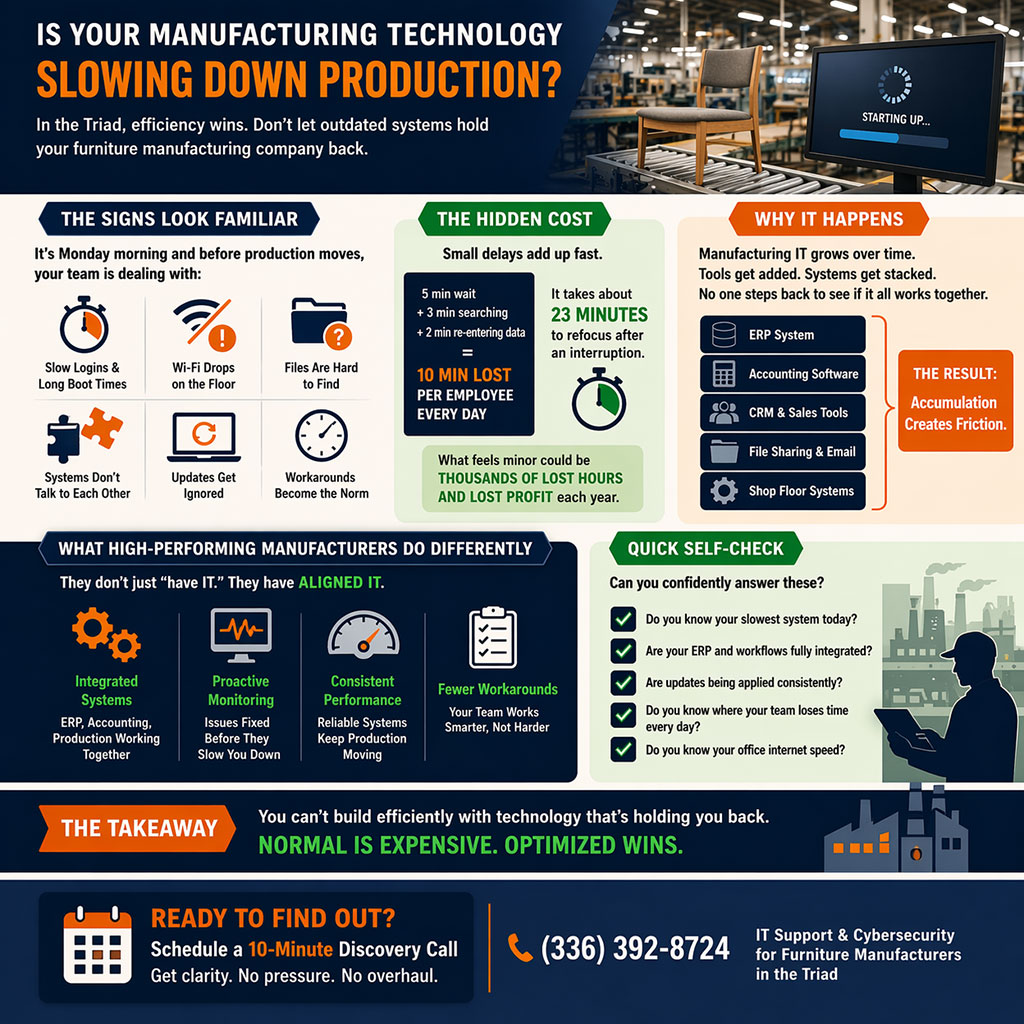
- A workstation takes minutes to boot
- Someone can’t log into the system
- The Wi-Fi drops in part of the building
- Files aren’t where they’re supposed to be
- Systems don’t sync properly
Nothing is “down.”
But everything is slower than it should be.
The Hidden Problem in Manufacturing IT Environments
Most furniture manufacturers don’t have catastrophic IT failures.
They have constant operational friction:
- slow systems
- disconnected software
- manual workarounds
- delayed approvals
- inconsistent performance
And in manufacturing, that friction doesn’t stay in IT.
It shows up as:
- 👉 production delays
- 👉 purchasing bottlenecks
- 👉 supplier miscommunication
- 👉 missed delivery timelines
This isn’t just a technology issue.
👉 It’s an operations and profitability issue.
Why This Happens in Furniture Manufacturing Companies
Over time, most manufacturing environments evolve like this:
- ERP system added
- Accounting software layered in
- CRM introduced later
- File sharing added separately
- Shop-floor systems bolted on
Each decision made sense at the time.
But no one steps back to ask:
Does this all work together efficiently?
Instead of a system…
You get accumulation.
And accumulated systems create drag.
What High-Performing Manufacturing Operations Do Differently
The most efficient manufacturers in North Carolina and Virginia don’t just “have IT.”
They have aligned systems.
That means:
- integrated software (ERP, accounting, production)
- proactive monitoring (not reactive troubleshooting)
- consistent system performance
- minimal manual workarounds
They don’t tolerate lag.
They eliminate it.
The Cost of “Small” Technology Problems
Most leaders don’t calculate this — but they should.
Let’s break it down:
- 5 minutes waiting on slow systems
- 3 minutes searching for files
- 2 minutes re-entering data
That’s 10 minutes per employee per day.
But interruptions don’t just cost time.
Research shows it takes ~23 minutes to refocus after disruption.
So that “10-minute delay” becomes:
👉 ~30 minutes of lost productivity
Now multiply that across:
- your office team
- operations
- purchasing
- finance
That’s hundreds — sometimes thousands — of lost hours per year.
The Real Issue: Technology Isn’t Being Managed Like Operations
Manufacturing leaders are disciplined about:
- production workflows
- quality control
- supply chain processes
But technology?
It’s often:
- ❌ reactive
- ❌ inconsistent
- ❌ unmanaged at a system level
That’s where the gap is.
A Simple Self-Assessment for Manufacturers
If you’re a manufacturer in the Triad, ask:
- Do you know your slowest system today?
- Are your ERP, accounting, and workflows fully integrated?
- Are updates being applied consistently across devices?
- Do you know where your team loses time every day?
If the answer is unclear — that’s your opportunity.
What This Means for Furniture Manufacturers in the Triad
In markets like:
- High Point (furniture capital)
- Greensboro (distribution + logistics)
- Winston-Salem (manufacturing + suppliers)
Efficiency is competitive advantage.
Companies that move faster:
- fulfill orders quicker
- communicate better with suppliers
- reduce costly errors
- protect margins
Technology plays a direct role in that.
The Better Approach: From Accumulation to Optimization
Most companies don’t need more tools.
They need:
- 👉 better alignment
- 👉 fewer inefficiencies
- 👉 proactive oversight
- 👉 systems designed for how they actually operate
That’s where co-managed IT and cybersecurity becomes valuable.
Not replacing your team.
👉 Supporting them with structure, visibility, and optimization.
The Takeaway
Your kid’s gaming setup is optimized because performance matters.
In manufacturing…
Performance matters more.
But most companies are still tolerating:
- slow systems
- disconnected workflows
- reactive fixes
Because it’s become “normal.”
And normal is expensive.

