
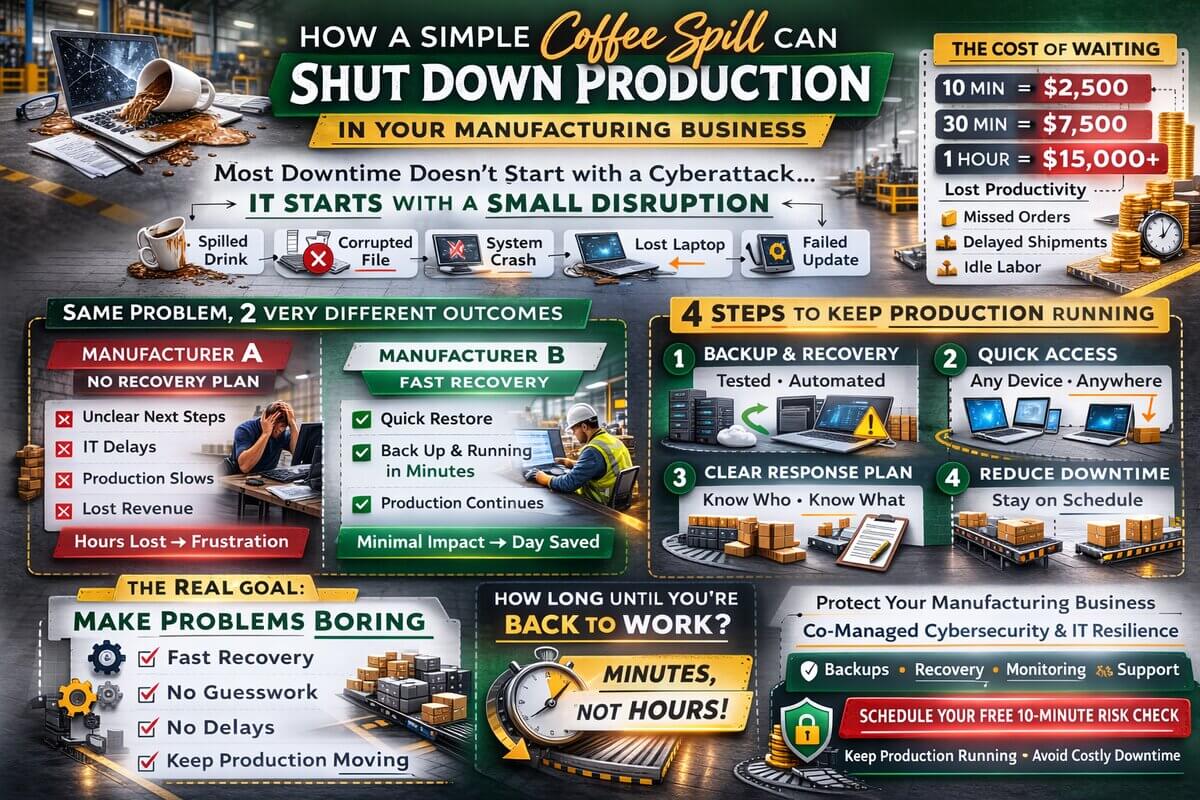
It’s Monday morning.
Coffee in hand. Laptop open. The day is starting.
Production schedules need review.
Orders need approval.
Vendors are waiting on responses.
Then it happens.
An elbow bumps a mug.
Coffee spills across the keyboard.
The screen flickers.
The system freezes.
Someone quietly says:
“I think I just broke something.”
No hackers.
No ransomware alert.
No dramatic cyberattack.
Just a normal moment that suddenly disrupts the day.
And in manufacturing environments, that’s often how downtime really begins.
Most Business Disruptions Aren’t Dramatic
When manufacturers think about downtime, they imagine major events:
- cyberattacks
- server failures
- complete system outages
But real operational slowdowns usually start much smaller:
- a damaged laptop
- a corrupted file
- a failed update
- a workstation that won’t boot
- lost access to shared systems
The mistake isn’t the problem.
What happens next is.
The Hidden Cost of “Waiting”
Here’s what typically follows a small technology issue:
One employee stops working.
Others try to help.
Someone contacts IT.
Work shifts temporarily elsewhere.
Ten minutes becomes thirty.
Thirty minutes becomes an hour.
Now multiply that across:
- accounting
- purchasing
- scheduling
- operations
- customer service
Production doesn’t fully stop.
It half-stops.
And half-working operations quietly drain productivity across the entire organization.
Same Problem. Two Very Different Manufacturing Outcomes
Let’s replay the same coffee spill.
Manufacturer A
- No defined recovery process
- Unclear ownership
- Files may or may not exist elsewhere
- Key support person unavailable
By midday, schedules slip and frustration spreads.
Manufacturer B
- Issue reported immediately
- Replacement access provisioned quickly
- Files restored automatically
- Employee back online fast
Same accident.
Completely different business impact.
The difference isn’t luck.
It’s recovery readiness.
Well-Run Manufacturers Make Problems Boring
The goal of technology leadership isn’t eliminating mistakes.
Mistakes are inevitable.
The goal is making problems boring.
Boring means:
✅ Clear response steps
✅ Fast recovery
✅ Minimal disruption
✅ No confusion about ownership
When recovery is predictable, small problems never reach operations.
Work simply continues.
This Is a Leadership Issue — Not an IT Issue
When minor incidents cause major slowdowns, the issue usually isn’t technology itself.
It’s uncertainty.
Common gaps include:
- No defined recovery expectations
- Responsibility tied to individuals instead of process
- Dependence on one internal expert
- No clear definition of “back to normal”
Manufacturing leaders excel at removing uncertainty from production.
Technology recovery deserves the same discipline.
One Question Every Manufacturing Leader Should Ask
If a small technology issue happened right now:
How long until your team is fully back to work?
Not eventually.
Not best case.
Actually operational again.
If the answer isn’t clear, that’s valuable information — not failure.
Because most lost productivity doesn’t come from disasters.
It comes from normal days that quietly go sideways.
The Real Takeaway
Successful furniture manufacturers don’t avoid problems.
They recover so quickly the problem barely matters.
Your technology doesn’t need to be perfect.
It needs to be:
- Recoverable
- Predictable
- Fast
- Operationally invisible
When recovery works well, mistakes become forgettable — and production keeps moving.
Next Steps
Many furniture manufacturers already have capable internal IT teams.
What leadership often wants is simply confirmation that recovery happens fast enough to protect operations.
A short review can help validate:
- workstation recovery speed
- operational downtime exposure
- backup and restore readiness
- co-managed cybersecurity gaps
No disruption.
No pressure.
Just clarity.

