
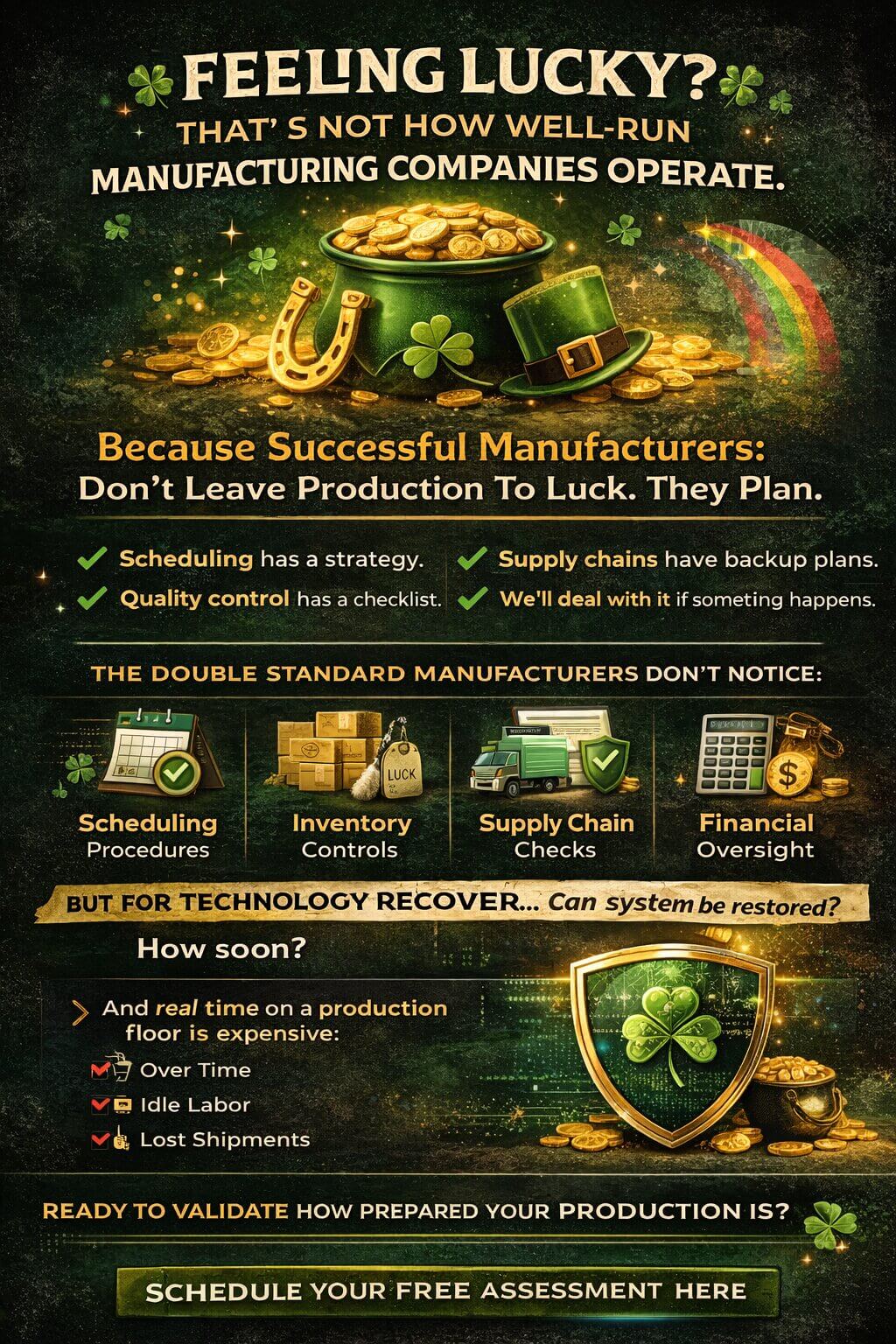
March brings shamrocks, green decorations, and talk about luck.
And luck is great — for holidays.
But successful furniture manufacturers don’t run their operations on luck.
No plant manager would ever say:
- “Production will probably stay on schedule.”
- “Inventory should work itself out.”
- “Quality control will sort itself out eventually.”
Manufacturing runs on planning, process, and predictability.
Yet surprisingly, many companies treat technology recovery very differently.
The Hidden Risk Most Manufacturers Don’t Notice
Across furniture manufacturing and supplier environments, we often see strong operational discipline everywhere except one critical area:
What happens when systems go down?
Production scheduling has procedures.
Supply chains have backup vendors.
Financial controls are documented and audited.
But technology recovery frequently sounds like:
“We’re probably backed up somewhere.”
Or:
“We’ll deal with it if something happens.”
That’s not preparation.
That’s optimism.
Successful Manufacturers Don’t Leave Production to Luck
Well-run operations plan for disruption before it happens.
They know:
✅ Scheduling has redundancy
✅ Supply chains have contingency plans
✅ Quality control follows repeatable processes
✅ Financial oversight prevents surprises
But when it comes to IT systems — ERP platforms, inventory systems, purchasing workflows, and communications — many organizations unknowingly rely on assumptions instead of validation.
And today, those systems are production infrastructure.
The Double Standard in Manufacturing Operations
Think about the standards applied across your business:
| Operational Area | Expectation |
| Production | Documented procedures |
| Inventory | Controlled tracking |
| Supply Chain | Verified partners |
| Finance | Continuous oversight |
Now compare that to technology recovery:
- Can systems actually be restored?
- How long would recovery take?
- Has recovery ever been tested?
- Who owns the process?
If those answers aren’t immediately clear, recovery may depend more on luck than leadership realizes.
Why Recovery Speed Matters on the Production Floor
Downtime in manufacturing isn’t theoretical.
It quickly becomes:
- Idle labor costs
- Missed shipments
- Overtime recovery expenses
- Customer delays
- Supply-chain disruption
The difference between a minor interruption and a major operational event usually comes down to one factor:
Preparation before failure.
Prepared Companies Make Disruptions Boring
The most resilient furniture manufacturers don’t avoid problems entirely.
They make recovery routine.
Preparation means:
- Tested backup and recovery systems
- Clearly defined recovery ownership
- Predictable restoration timelines
- Minimal operational interruption
When something breaks — and eventually something will — prepared organizations simply return to work.
No panic.
No guesswork.
No drama.
A Simple Leadership Reality Check
Ask yourself:
If your production team managed operations the same way technology recovery is handled today, would it be acceptable?
“We think the process works.”
“Someone probably checked recently.”
“We’ll figure it out if the line stops.”
Of course not.
Technology deserves the same operational discipline as every other part of your business.
The Takeaway
St. Patrick’s Day celebrates luck.
Manufacturing success does not.
Furniture manufacturers succeed because they plan, validate, and prepare — not because problems never occur.
Technology recovery should follow the same standard.
Because when systems fail, the real question isn’t:
“Were we unlucky?”
It’s:
“Were we prepared?”
Ready to Validate Your Preparedness?
Many furniture manufacturers already have capable internal IT teams.
What leadership often wants is simply independent validation that recovery and cybersecurity protections will actually hold up under pressure.
A short review can help confirm:
- production recovery readiness
- backup reliability
- cyber-insurance alignment
- co-managed cybersecurity gaps
No scare tactics.
No disruption to operations.
Just clarity.

